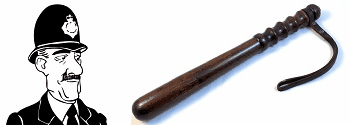

The 1941 Wartime Emergency Truncheon Specification
Why the War Office Had to Compromise
When the War Office issued its original truncheon specification in May 1926, it assumed something that would no longer hold true fifteen years later: that exotic hardwoods could be sourced reliably and in sufficient quantity.
By 1941, that assumption had collapsed.
The Second World War, and in particular the Battle of the Atlantic, placed enormous strain on Britain’s supply lines. Shipping losses were heavy, imports were disrupted, and priorities shifted sharply towards food, fuel, armaments, and critical war materials. Items that had once been routine to procure suddenly became scarce or unobtainable.
The truncheon was hardly a strategic weapon, but it was still controlled equipment issued to War Department Constabulary personnel, military prisons, and later military police units. Supply could not simply stop.
The Wartime Emergency Amendment
Rather than abandoning the specification altogether, the War Office issued a formal wartime emergency amendment to the existing truncheon specification.
This is an important point. The original 1926 standard was not ignored or quietly bypassed. It was officially modified to reflect wartime reality.
The amendment acknowledged that the originally specified tropical hardwoods could no longer be relied upon and authorised alternative timbers that could be sourced domestically or with far greater reliability.
Approved Substitute Woods
Under the wartime emergency provisions, the following woods were permitted in place of the originally specified exotic hardwoods:
- Oak
- Birch
- English beech
These were not chosen at random. All three were readily available within the United Kingdom, could be supplied in volume, and offered acceptable strength and durability when properly seasoned and worked.
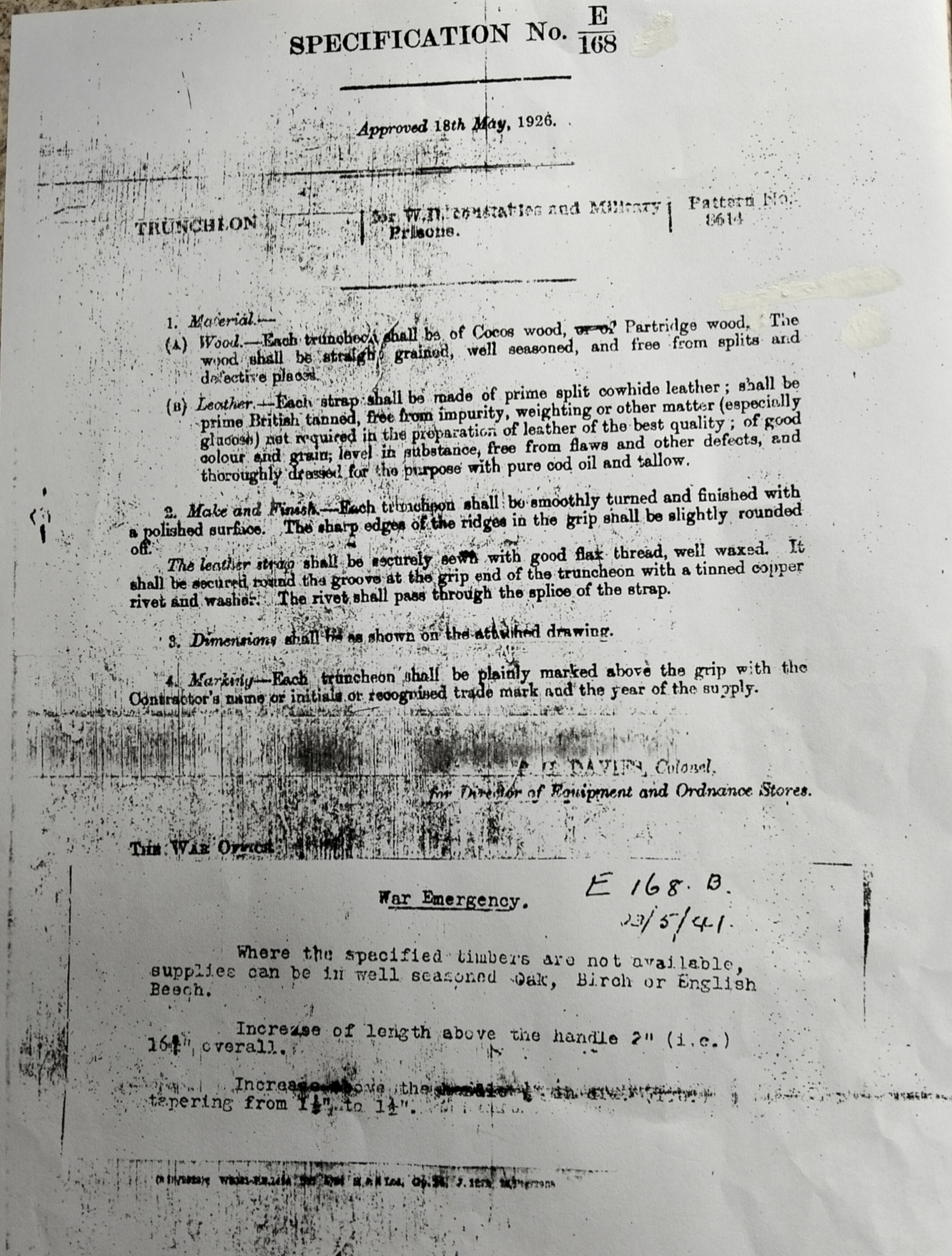
Truncheons specification
This amendment explains why densified beech, often referred to by its trade name Lignestone, begins to appear during and after the war years. Beech was abundant, and when compressed and impregnated, it produced a material with mechanical properties suitable for hard service use.
What Changed, and What Did Not
Although the permitted materials changed, much of the original specification remained intact.
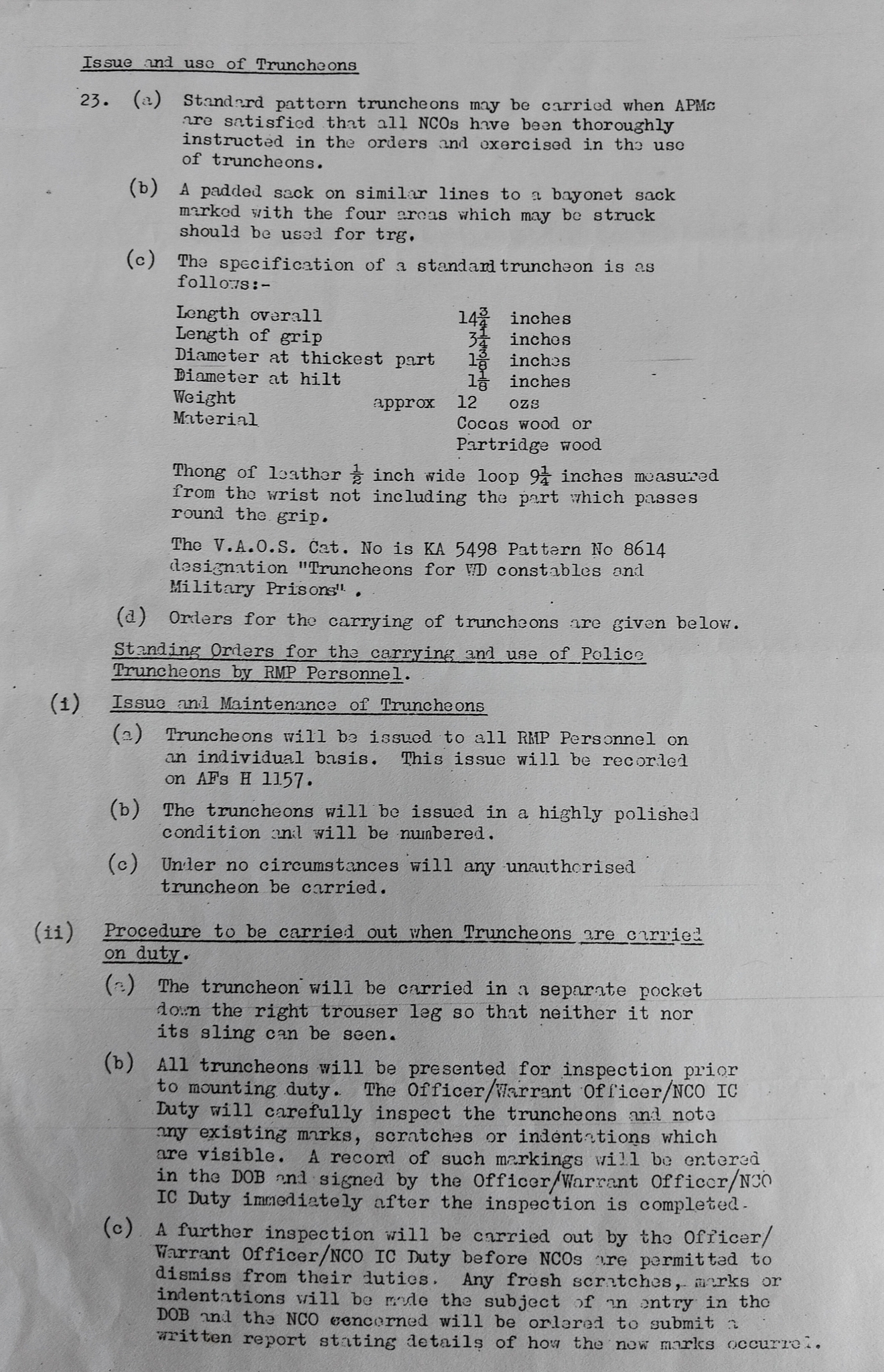
Dimensions, general form, finish, and the requirement for a proper leather thong were all retained. The truncheon was still expected to meet the same functional and handling standards set out in 1926.
What changed was the War Office’s tolerance for material substitution, driven not by fashion or preference, but by necessity.
The Beginning of Genuine Variation
This wartime amendment marks the point at which genuine material variation becomes unavoidable.
Once multiple woods were formally authorised, different suppliers could meet the specification while producing truncheons that differed noticeably in colour, grain, density, and feel. All could be correct. All could be compliant.
This is the root of much later confusion among collectors. Variations that are sometimes assumed to be post-war improvisations or unofficial substitutions often trace directly back to this 1941 emergency measure.
Why This Matters
The wartime amendment demonstrates that variation in War Office and later Ministry of Defence truncheons was not the result of poor control or lax standards. It was the product of an official, documented response to wartime supply constraints.
Understanding this change is essential before attempting to assess later truncheons by material alone. Without this context, it is easy to misinterpret legitimate service items as anomalies.
The paper trail makes clear that, by 1941, the War Office had accepted that uniformity of material was no longer realistic. Practical serviceability took precedence.
This sets the stage for what follows: multiple suppliers, multiple woods, and a much wider range of surviving examples than the original 1926 document might lead one to expect.
If you want a traditional British police-style wooden truncheon, we sell a replica of a 1960s Leeds City Police issue, complete with leather lanyard, at a very reasonable price.
Click the button below to find out more.