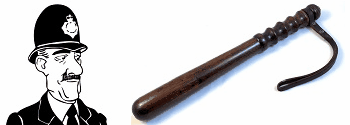

An Unusual Truncheon with a Unique History
We occasionally come across an unusual truncheon that stands out for its unique characteristics. Recently, we acquired such a truncheon, and the story is worth sharing.
This is an update. When this article was first written, we genuinely did not know what it was.
As many of our readers will already know, platforms like eBay prohibit the sale of truncheons outright, even antique examples, by classifying them as “offensive weapons” (baseball bats and rolling pins, for reasons known only to eBay, remain perfectly acceptable). As a result, interesting pieces often emerge in unexpected ways, often stripped of any substantial background information.
This one came to us via a lady clearing her grandmother’s house after her passing. She attempted to sell it on eBay, the listing was promptly cancelled, and after a bit of searching, she found our website and contacted us directly.

The photographs immediately caught our attention.

The truncheon is slightly smaller than a typical British police truncheon, retains its original leather lanyard, and has a shape we hadn’t seen before. The striking end is slightly pointed and bulbous, while the grip is noticeably slimmer than usual. At the time, we even half-joked that it might have been made for a lady (no, not in that way), simply because the proportions were unusual.

It is also heavier than it looks.
At 38.5 cm long, approximately 34 mm at its widest point, and weighing 340 g, it felt too dense to be oak but didn’t immediately suggest lignum vitae either. Based on the turning and finish, we dated it loosely to the early to mid-1900s, but beyond that, we couldn’t be certain.
The seller could offer very little background. It had belonged to her grandmother, and given the family’s mixed history, she speculated it might have come from the police, the railways, or the military. Helpful, but not exactly narrowing it down.

At the time of the original article, we leaned tentatively towards a railway truncheon, largely because it didn’t match any police pattern we recognised and didn’t resemble the military or prison service truncheons we were familiar with either.

As it turns out, that assumption was wrong.
Some time after the article went live, a collector named Rob contacted us with detailed information, and crucially, information that can actually be substantiated rather than repeated as hearsay.
The wood is not oak or lignum vitae. It is Partridgewood, a trade name for Caesalpinia ebano, a dense South American hardwood found in Colombia and Mexico, where it is also known as Guayavilla negro. This species typically has a density in the region of 1200–1300 kg/m³, which neatly explains why the truncheon feels disproportionately heavy for its size.
More importantly, the shape itself stops being “odd” once you know what you are looking at.
This truncheon is a War Office pattern, formally introduced in May 1926 for use by War Department Constables and Military Prisons. The date refers to the introduction of the pattern, not the manufacture date of this individual example.
From that point onward, this pattern, with only minor variations, became standard issue for Military Police. At the time, no commercial or alternative patterns were permitted to be carried by these services, which explains why it doesn’t resemble civilian police or railway truncheons.
The proportions that originally confused us, particularly the slimmer grip and distinctive striking end, are deliberate features of the pattern rather than anomalies.
When the Ministry of Defence came into existence in 1964, all three provost branches were confined to this same pattern. Before that, the Admiralty and the Air Ministry had sourced truncheons separately for the Admiralty Constabulary and the Air Force Department Constabulary, respectively.
So what initially appeared to be a one-off oddity turns out to be a very specific and tightly controlled military issue design dating from the inter-war period and continuing in service for decades afterwards.
We are grateful to Rob for supplying proper, verifiable information and for taking the time to correct the record. This is exactly how obscure pieces like this get properly identified, by people who actually know what they are looking at, rather than by guesswork.
If you have period documentation, photographs, or further information relating to War Office or Military Police truncheons, we are always happy to hear from you.
If anyone fancies this in their collection, you can give us a bid for it. Contact us here.
If you want a traditional British police-style wooden truncheon, we sell a replica of a 1960s Leeds City Police issue, complete with leather lanyard, at a very reasonable price.
Click the button below to find out more.